Product Design · Mobile · India · 2026

KOSHA

Adaptive Financial Operating System
for India's UPI Economy

Track
→
Understand
→
Predict
→
Prepare
Role
Sr. UX Designer
Duration
8 Weeks
Platform
iOS · Android
Market
India · UPI
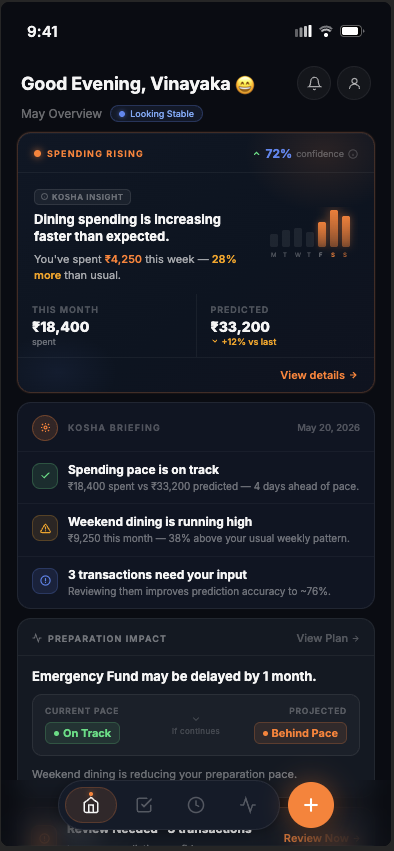
KOSHA Home Screen
14
Billion+
UPI transactions processed every month in India.
The Observation

Despite having more financial data than ever before, people still struggle to understand where money goes, why spending changes, and whether they are prepared for what comes next.

India processes more digital payments than almost any country on earth. Yet financial clarity remains elusive — because the volume of data is not the same as depth of understanding. The gap between transaction and meaning is where KOSHA lives.

ChallengeUPI makes spending frictionless — but memory of that spending is broken. Ambiguous metadata destroys categorisation, which breaks predictions, which kills confidence. India's fastest payment rail had no financial intelligence layer built for how real people actually use it.
Approach12 in-depth interviews with UPI users across income brackets, a competitive audit of 6 products, and eight weeks of design across onboarding, home, review, planning, and insight flows — anchored by seven principles derived directly from research failures.
ResultKOSHA: an adaptive financial OS that learns from ambiguous UPI data, surfaces confidence progressively, and treats preparation as readiness — not restriction. 8 end-to-end flows. A position no existing product occupies.
The Problem
Budget apps explain the past.
Life happens in the future.

During research, I discovered that users rarely struggle with seeing where money went. They struggle with understanding whether they are financially prepared for what comes next — a problem amplified in India by UPI's ambiguous transaction metadata.

Real UPI Transaction Names — What Users Actually See
RK
Ravi Kumar
UPI/P2P/9182736450@ybl · Jul 12 · 6:14 PM
₹450
Unknown
S
Suresh
UPI/P2P/7654321098@okaxis · Jul 14 · 1:22 PM
₹1,200
Unknown
📱
8876543210
UPI/P2M/Q23847@paytm · Jul 15 · 8:47 PM
₹680
Unknown
🏪
MERCHANT8374@paytm
UPI/P2M/019283746510 · Jul 16 · 11:05 AM
₹340
Unknown
✦
8876543210
KOSHA → Local Kirana Store · Groceries
₹680
Resolved
KOSHA"Users cannot recall what a transaction was for — this destroys the reliability of every prediction downstream."
01
Users lose confidence in categorization
When "Ravi Kumar" could be rent, lunch, or a debt repayment — users stop trusting the categories the app assigns. The data exists but the meaning is invisible.
02
Monthly summaries become unreliable
Incorrect categories cascade into misleading spending summaries. A ₹5,000 transfer to a friend appears as "Shopping." The picture is wrong before predictions even begin.
03
Future predictions become untrustworthy
Bad input produces bad forecasts. Without reliable categorization, KOSHA cannot predict future spend — the entire value proposition collapses at the foundation.
Problem Statement
"Due to ambiguous UPI transaction metadata in India, users are unable to recall and categorize daily micro-expenses, leading to inaccurate financial tracking and unreliable predictions."
Research Insights

Three insights that
changed the product.

12
In-depth interviews across
income brackets & cities
280+
UPI transactions reviewed
with participants
28
Pain points
synthesized
Insight 01 · Confidence
01
Users don't need perfect categorization. They need confidence.
Most participants were comfortable with approximate financial awareness — as long as they trusted the overall picture. Accuracy is not the goal. Trust is the goal. This single insight shifted the entire design direction.
"I don't need to know every rupee. I just need to know I'm okay."
"As long as the big numbers feel right, I trust it."
"I abandoned the last app because it felt broken, not wrong."
Insight 02 · Future Anxiety
02
Future expenses create more anxiety than past spending.
Most budgeting tools focus on where money went. But users were far more anxious about upcoming obligations they hadn't prepared for. The past was regret. The future was dread.
School fees · Insurance renewals
Vehicle servicing · Travel plans
Medical expenses · Annual subscriptions
Insight 03 · Progressive Trust
03
Financial confidence is built progressively, not upfront.
Users cannot provide perfect financial information on day one. Demanding complete setup before delivering value guarantees abandonment. The product must earn trust through each interaction — not assume it from the start.
"Every other app asked too much before giving anything back."
"I gave up on setup when it asked for 6 months of history."
Avg. app abandonment: within 5 days of install
Design Opportunity
"How might we help Indian users progressively build financial confidence while preparing for future obligations — despite incomplete data, ambiguous transactions, and unpredictable spending behaviour?"
User Research · Personas

Three archetypes. One shared anxiety.

Grounded in exploratory conversations with UPI users across income brackets, cities, and financial behaviours — supplemented by transaction pattern analysis and a review of recurring complaints in Indian personal finance communities.

👨‍💻
Arjun
The Anxious Earner · 26–32
"I know I should have more money by now. Every month I feel confused about where it went."
Income
₹60–90k/mo
City
Bengaluru
UPI Use
Daily
Pain Points
↓UPI to "Ravi Kumar" — no idea what for
↓Month-end balance never matches expectations
↓Upcoming expenses feel like financial ambushes
KOSHA Fit
Selective reviews + Confidence Score + Preparation Funds. Primary persona.
👩‍🏫
Priya
The Careful Planner · 30–38
"I track everything in a spreadsheet, but still get surprised by expenses I forgot were coming."
Income
₹45–70k/mo
City
Pune / Chennai
Pain Points
↓Insurance and school fees arrive as crises
↓Husband's UPI transactions unrecognizable
↓Spreadsheet maintenance is time-consuming
KOSHA Fit
Preparation Funds solve the annual expense ambush directly.
👨‍💼
Kiran
The Passive Starter · 23–27
"I downloaded three finance apps. Each wanted too much before giving anything back."
Income
₹30–50k/mo
City
Hyderabad
Pain Points
↓Apps show empty dashboards for weeks
↓Categorization feels like homework, not help
↓No sense of financial progress
KOSHA Fit
Early Value Strategy delivers awareness day one.
Competitive Analysis

How KOSHA stacks up against the market.

Evaluating leading personal finance apps across Indian and global markets on core financial management, intelligence & understanding, preparation & planning, and adaptive intelligence.

Legend
✓ Strong
△ Partial
✗ Missing
Capability Indian Apps (60%) Global Apps (40%) KOSHA
Fold CRED Money Jupiter Fi ET Money GPay / PhonePe YNAB Goodbudget Qapital MoneyWiz KOSHA
A · Core Financial Mgmt
Account Aggregation
✓✓△△✓✓△✗△✓✓
Expense Tracking
✓✓✓✓✓✓✓✓△✓✓
Auto Categorization
✓✓✓✓✓✗△✗✗✓✓
B · Intelligence & Understanding
UPI Ambiguity Handling
✗✗✗✗✗✗N/AN/AN/AN/A✓
Selective Review Flow
✗✗✗✗✗✗✗✗✗✗✓
Confidence Transparency
✗✗✗✗✗✗✗✗✗✗✓
Behavioral Insights
△△△△△✗△✗✗△✓
Understanding Before Analytics
✗✗✗✗✗✗✗✗✗✗✓
C · Preparation & Planning
Preparation / Sinking Funds
△✗△✗✗✗✓✓✓△✓
Adaptive Preparation
✗✗✗✗✗✗✗✗△✗✓
D · Adaptive Intelligence
Early Value Strategy
△△△△△✗✗✗✗✗✓
Adaptive Assistant
✗✗✗✗✗✗✗✗✗✗✓
Interruptions Adapt
✗✗✗✗✗✗✗✗✗✗✓
Confidence Evolution
✗✗✗✗✗✗✗✗✗✗✓
Key Patterns Observed
01
Apps optimize for TRACKING, not UNDERSTANDING
Track → Categorize → Visualize  ·  Missing: Understanding
02
Tools focus on PLAN, CONTROL, and RESTRICT
Plan → Control → Restrict  ·  Missing: Prepare
03
UPI ambiguity remains largely UNRESOLVED
RAVI KUMAR | SURESH | MOBILE NUMBER → Poor categorization
04
Most systems assume CERTAINTY
Very few communicate Confidence · Learning · Uncertainty
05
Value arrives only AFTER sufficient historical data
Connect → Wait → Wait → Insights  ·  Users drop off before value
Opportunity Areas
01 · UPI Ambiguity
Selective Reviews
For low-confidence or high-impact transactions
02 · Delayed Value
Early Value Strategy
Delivers awareness and understanding from day one
03 · Budget Fatigue
Adaptive Preparation
Funds that promote readiness, not restriction
04 · Black Box AI
Confidence Transparency
Communicate what the system knows (and doesn't)
05 · Repeated Effort
Confidence Evolution
System learns over time and reduces user effort continuously
Why KOSHA Exists
Existing apps help users track money.
KOSHA HELPS USERS
UNDERSTAND, PREPARE,
AND BUILD CONFIDENCE.
🔍
Track
Capture & organize
→
💡
Understand
Explain with signals
→
🔮
Predict
Forecast with confidence
→
🛡️
Prepare
Build readiness proactively
→
⭐
Adapt
Personalize & reduce effort
NOT A BUDGETING APP

KOSHA is a financial preparedness system.

The goal is not to tell users what happened. The goal is to help users feel prepared for what is coming next. Most finance products focus on historical spending. KOSHA focuses on future readiness.

Traditional Model
track + report
Tells you what happened last month. Optimizes for completeness. Offers no forward view.
KOSHA Model
predict + prepare
Tells you what's coming next month. Optimizes for confidence. Reduces effort over time.
The Core Shift
"Am I prepared?" is a more powerful question than "Where did my money go?"
Design Principles

Seven principles that guided every product decision.

Rather than designing features independently, I established a set of principles that ensured every interaction contributed toward one goal: helping users build financial confidence through progressive intelligence and adaptive preparedness.

Principle 01
Deliver Value Before Intelligence
Users should gain value immediately, even before reliable predictions exist.
Why it matters
Most finance apps require weeks of data collection before becoming useful. Users abandon before they see value.
Applied in
Early Value Flow
Onboarding
Awareness Signals
Limited Mode
Examples
Salary detection on day one
Recurring payment discovery
Unclear transaction reviews
Principle 02
Process Everything. Interrupt Selectively.
The system evaluates every transaction but only surfaces meaningful uncertainty.
Why it matters
Constant categorization requests create fatigue and abandonment. Silence is a feature.
Applied in
Review Flow
Signal Layer
Confidence Engine
Examples
Low-confidence reviews only
High-impact ambiguity flagged
Grouped transaction reviews
Principle 03
Preparedness Over Restriction
Help users prepare for upcoming responsibilities rather than control spending behaviour.
Why it matters
Traditional budgeting often feels punitive and restrictive. Preparation feels supportive and forward-looking.
Applied in
Plan Experience
Preparation Funds
Adaptive Suggestions
Examples
Insurance preparation
School fee preparation
Festival preparation
Emergency buffers
Principle 04
Transparency Builds Trust
The assistant should openly communicate uncertainty rather than pretend confidence.
Why it matters
Financial decisions require clarity, honesty and trust. Black-box recommendations destroy credibility.
Applied in
Confidence Evolution
Review Flow
Assistant Explanations
Examples
Confidence indicators on every prediction
Learning states shown to user
Prediction transparency ("How we know")
Principle 05
Understanding Before Analytics
Translate financial activity into human understanding rather than charts alone.
Why it matters
Most users don't need more graphs. They need clarity and context.
Applied in
Signal Layer
Insights Experience
Assistant Interpretation
Instead of showing
📈Dining+18%
KOSHA explains
"Most of the increase came from weekend dining rather than weekday spending."
Principle 06
Adapt To The User
Assistant behaviour should evolve based on user engagement and preferences.
Why it matters
Different users have different interruption tolerances and needs. One mode does not fit all.
Applied in
Minimal Mode
Balanced Mode
Detailed Mode
Minimal — fewer notifications, core signals only
Balanced — recommended default mode
Detailed — full insight depth + review cadence
Principle 07
Reduce Effort Over Time
Every interaction should make future interactions easier. Intelligence should compound.
Why it matters
Intelligence should compound and reduce user effort. The more you use KOSHA, the less you have to do.
Applied in
Confidence Evolution
Review Flow
Assistant Learning
↓
Fewer reviews needed each cycle
✓
Better categorization accuracy
⚡
Smarter signals surfaced
Our North Star Flow
🎁
Value
Immediate value builds trust and engagement
›
💡
Understanding
Assistant translates data into meaningful insights
›
🔮
Prediction
Confidence grows as the system learns from you
›
⚙️
Adaptation
Assistant adapts to your behaviour and preferences
›
🛡️
Confidence
Financial confidence improves while effort reduces
"
Rather than designing features independently, I established a set of product principles that ensured every interaction contributed toward a single goal: helping users build financial confidence through progressive intelligence and adaptive preparedness.
The Confidence Engine

A self-reinforcing
learning loop.

Instead of presenting financial data as absolute truth, KOSHA continuously measures and communicates confidence. Every review improves accuracy. Every accurate prediction strengthens preparation.

✓
Step 01
User Reviews a Transaction
A low-confidence or high-impact transaction surfaces in the review queue. The user confirms or corrects the category.
↑
Step 02
Confidence Score Increases
The Confidence Engine updates its model. The overall score rises. The user sees this improvement immediately.
◎
Step 03
Prediction Accuracy Improves
Better categorization means KOSHA can forecast spending patterns more reliably.
✦
Step 04 · Result
Preparation Quality Strengthens
Stronger predictions lead to better preparation. Fewer reviews needed next cycle. Effort decreases while confidence grows.
KOSHA
ENGINE
Review
Predict
Confidence
Prepare
Category Confidence
Signal Scoring
Preparation Engine
Learning & Adaptation
Confidence Evolution Over Time
29%
Day 1
42%
Week 2
61%
Month 1
76%
Month 2
88%+
Month 3+
Illustrative values — shown to demonstrate system behaviour, not measured model output
Traditional Budgeting Apps
Assume. Display. Repeat.
1
User Action
Connect account, add transactions
2
System Response
Auto-categorize (often wrong), display chart
3
User Confusion
Wrong categories, misleading summaries
4
No Learning
Same mistakes repeat every month
Result: Low trust. High effort. Repeated abandonment.
KOSHA Approach
Review. Learn. Adapt.
1
User Action
Connect account — immediate value starts
2
Assistant Interpretation
Surfaces only low-confidence items for review
3
System Learning
Model updates with each confirmed category
4
Future Effort Reduces
Fewer reviews needed, better predictions
Result: More understanding. Less effort. Growing confidence.
Financial Confidence Journey

How KOSHA transforms financial uncertainty
into confidence.

Through awareness, understanding, prediction and preparedness — across 7 stages of a user's financial month.

Journey Stages
1
💳
Salary Received
2
🛒
Daily Spending
3
❓
Transaction Ambiguity
4
📊
Mid-Month Drift
5
📅
Upcoming Responsibility
6
🎯
End of Month
7
📈
Month 2+
Before KOSHA
How users manage finances today
No clear plan
Salary received
No planning
Mental budgeting
Hope it works out
Transactions forgotten
Many UPI transactions
Small expenses go unnoticed
Lose track of spending
Unclear transactions
Unfamiliar payments
"Who was Ravi Kumar?"
No clarity, move on
Spending feels random
Money disappearing faster
No idea why
Reactive behavior
Bills cause stress
Insurance / EMI / Travel suddenly due
Last-minute arrangements
Cash flow pressure
No clear picture
Where did my money go?
No understanding of behavior
Same cycle repeats
No learning from previous months
Mistakes repeat
No improvement
With KOSHA
How Kosha changes the experience
Month starts with clarity
Salary detected
Preparation funds updated
Upcoming pressures visible
Spending awareness maintained
Transactions auto processed
Only important items surface
Always stay in control
Selective review brings clarity
Unclear transactions flagged
Quick review & clarity
Confidence improves
Signal layer highlights drift
Spending change detected
Impact on preparation visible
Adjustment options available
Prepared, not stressed
Preparation fund already active
Coverage visible
Pressure anticipated in advance
Clear understanding of the month
Spending summary with meaning
Behavior patterns understood
Better decisions
Intelligence adapts to you
Fewer reviews needed
More accurate predictions
Better suggestions
Key Assistant Role
What Kosha does in the background
Detects salary & anchors the month
Establishes baseline for planning & preparation
Processes transactions in real-time
Keeps spending visible without manual effort
Asks only when uncertainty exists
Selective reviews build understanding faster
Surfaces important changes
Signal layer brings what matters to your attention
Monitors preparation health
Ensures you're prepared for what's ahead
Generates insights with meaning
Turns data into understanding
Learns & adapts continuously
Improves accuracy, reduces interruptions, increases trust
Emotion Before → After
Emotional shift at each stage
Before
😐Neutral
After
😊Hopeful
Before
😕Confused
After
👀Aware
Before
😟Uncertain
After
😌Relieved
Before
😰Anxious
After
😎In Control
Before
😣Stressed
After
😊Prepared
Before
😤Frustrated
After
😊Satisfied
Before
😞Discouraged
After
🙌Confident
Confidence Evolution with KOSHA
Day 1
Awareness
I can see what is happening.
Week 2
Understanding
I can understand my behavior.
Month 1
Prediction
I can anticipate what is coming.
Month 3+
Adaptation
The system adapts to me.
Prediction Confidence Increases Over Time
Emotional Journey Curve
Stress and confidence levels across the financial month
High Stress Neutral High Conf. Salary Daily Ambiguity Mid-Month Upcoming End
Before KOSHA
With KOSHA
KOSHA vs Traditional Apps

From tracking transactions
to building financial confidence.

Five real scenarios. What happens today with traditional apps — and what happens with KOSHA.

Scenario
Traditional Apps
What happens today
KOSHA Approach
What happens with Kosha
Key Difference
Scenario 01
Ambiguous UPI Transaction
e.g. Payment to "Ravi Kumar"
Transaction arrives→Auto categorized as "Others"→User sees it later in reports→Confusion continues
Transaction arrives→Low confidence detected→Review card appears→User confirms category→Learns & future reviews reduce
💡
From guessing categories to learning and getting smarter over time.
Scenario 02
Spending Increasing
e.g. Dining +18%
Spending increases→Dashboard updates chart→User interprets graph→No deeper understanding
Spending increases→Assistant interprets pattern→Signal generated with context→User understands why→Can take the right action
💡
From data shown to insights explained in human terms.
Scenario 03
Upcoming Responsibility
e.g. Insurance due next month
Bill arrives on due date→Balance takes a hit→User reacts after impact→Stress & last minute pressure
Responsibility detected early→Preparation fund created→Coverage monitored→Timely signals & suggestions→User is prepared in advance
💡
From reacting to preparing in advance.
Scenario 04
User Ignores Notifications
e.g. Review requests
Notification sent→User ignores→More notifications→More noise, more friction
Notification sent→User ignores→Assistant detects low engagement→Fewer, smarter prompts→Only what matters
💡
From more notifications to fewer, smarter interactions.
Scenario 05
New User Journey
Just joined the app
Connect account→Collect data→Wait for weeks→Insights come later
Connect account→Salary detected→Recurring payments found→Unclear items surfaced→Early value & awareness
💡
From delayed value to early awareness and confidence.
Information Architecture

Five zones. One coherent system.

The complete structural map of KOSHA — primary navigation zones, sheet layers, and two onboarding entry paths.

Primary App Zones · 5 Screens
🏠
Home
Signal layer + briefing + preparation overview
AI Signal Card
Primary insight with confidence % + chart
KOSHA Briefing
3 prioritized daily signals
Preparation Impact
How today's spending affects funds
Review Needed
Compact review CTA card
Active Funds
Emergency + Vacation fund cards
✅
Review
Selective review queue + confidence evolution
Confidence Header
Ring + % + pending count
Priority Queue
3 items · Sort by Impact
Batch Card
Grouped similar transactions
Impact Summary
What reviewing improves
Recently Learned
System learning history
Confidence Graph
42% → 61% → 72% evolution
⏱️
Plan
Preparation funds + upcoming responsibilities
Preparation Overview
68% prepared · 4 active funds
Emergency Fund
On Track · ₹8k/₹12k · +₹2k/mo
Vacation Fund
Behind Pace · Apply Suggestion
Due Soon
Insurance · 16 days · Needs Attention
Plan Payment
Uncovered ₹4,700 → resolve
⚡
Insights
Behavioral patterns + smart recommendations
Featured Insight
Weekend pattern + "How we know"
Weekend Drift
+28% · Impacts preparation
Stable Essentials
Consistent · Positive signal
Late Night Impulse
10PM+ · Beware window
Safe Spending Range
₹6,500 discretionary
Spending Rhythm
Time × Day heatmap
⚙️
Settings
Mode · Accounts · Preferences · How Kosha Thinks
How Kosha Thinks
Transparency screen · full explanation
Assistant Mode
Minimal / Balanced / Detailed
Connected Accounts
Bank connections via AA
Notification Prefs
Frequency + review cadence
Privacy
Data control + AA management
Sheet Layer · Bottom Sheet Overlays (14 Sheets)
sh-review · Single Review sh-review · Batch Review sh-assistant · AI Chat sh-fund-vacation · Fund Detail sh-fund-vac-detail · Edit Fund sh-apply-suggestion · Apply Adjustment sh-action-center · FAB Hub sh-ac-fund · Create Fund sh-ac-resp · Add Responsibility sh-ac-income · Update Income sh-ac-adjustment · Adjustment sh-insurance-detail · Due Item sh-risk-home · Risk View sh-capture · Quick Add
Onboarding Flow · 9 Steps · 2 Entry Paths
Welcome
Splash
Value Prop
UPI Problem
Entry Mode
AA / Limited
Consent
AA Permissions
Bank Select
Multi-select
Income
Detected / Manual
Mode
Min / Bal / Detail
Confidence
Starting 29%
Dashboard
Early Value
Path A · Full Connect
Account Aggregator connected. Full transaction access. Highest value from day one. Recommended.
Path B · Limited Mode
Skips AA consent. Manual income entry. Reduced intelligence. Upgradeable to Full Connect later.
Service Blueprint

How KOSHA delivers financial confidence through AI-assisted intelligence.

Five service moments — from connecting accounts to long-term learning — mapped across customer journey, frontstage, assistant behaviour, backstage system, and support processes.

Service Moments
1
Connect Accounts
User connects bank accounts via AA
2
Review Transaction
User reviews an unclear transaction
3
Create Preparation Fund
User creates a fund for upcoming responsibility
4
View Signal
User views a signal on home screen
5
Use KOSHA Over Time
User continues using Kosha and builds consistency
👤
Customer Journey
What the user does
Downloads Kosha
Connects bank via AA
Confirms details
Sees transaction in feed
Reviews unclear item
Confirms / edits category
Enters goal and amount
Sets target date
Reviews suggested pace
Opens home screen
Sees prioritized signal
Reads insight
Uses app regularly
Takes actions
Builds financial confidence
Line of Interaction
👁️
Frontstage
Visible to user
AA Consent Flow
Clear permissions
Security assurance
Progress indicator
Review Card Appears
Merchant & amount
Why we're asking
Confirm / Edit options
Fund Created
Fund summary card
Coverage & timeline
Suggested monthly pace
Signal Card Shown
What's happening
Why it matters
Suggested action
Confidence Growth
Confidence score
Insights improve
Fewer interruptions
Line of Visibility
✦
Assistant Behavior
How Kosha assists
Explains Trust & Security
Why we need access
How data is used
You're in control
Explains Uncertainty
Why we're unsure
Helps you correct
Improves accuracy
Suggests Contribution Pace
Based on cash flow
Adjusts for priorities
You can modify
Prioritizes What Matters
Highlights impact
Keeps it simple
Actionable next step
Reduces Interruptions
Learns your behavior
Asks less over time
More autonomy
Line of Internal Interaction
⚙️
Backstage System
Processes behind the scenes
Income Detection
Salary identification
Cash flow mapping
Baseline created
Confidence Model Update
Category confidence
User correction learnt
Model recalibrated
Preparation Fund Calculation
Target vs cash flow
Pace calculation
Coverage projection
Signal Scoring Engine
Detects changes
Scores impact
Ranks importance
Prediction Reliability Improvement
More data points
Patterns strengthen
Predictions improve
🗄️
Support Processes
Foundational systems
Account Aggregator Engine
Secure data access
Encrypted transfer
Consent management
Category Confidence Engine
Merchant database
ML classification
Confidence scoring
Adaptive Preparation Engine
Fund modeling
Scenario engine
What-if analysis
Pattern Recognition Engine
Trend detection
Anomaly detection
Seasonality analysis
Learning & Personalization Engine
Behavior learning
Preference adaptation
Assistant tuning

"Every interaction helps Kosha learn, adapt, and support you better — creating a compounding cycle of clarity, preparedness and confidence."

Key Insight

Kosha is not just a budgeting app. It is a continuously learning system where user actions, assistant behavior, and system intelligence evolve together to build financial confidence.

Legend
Customer Journey
Frontstage (Visible)
Assistant Behavior
Backstage System
Support Processes
The KOSHA Difference
Traditional Apps
User Action →
System Response
vs
KOSHA Approach
User Action ↓
Assistant Interpretation ↓
System Learning ↓
Future User Effort Reduces
Outcome
🧠
More understanding
⚡
Less effort
🎯
Better predictions
🛡️
Stronger financial confidence
User Flows

Key flows mapped to interactions.

Four primary user flows — Home, Review, Plan, and Insights — showing how each task moves from trigger to resolution within KOSHA.
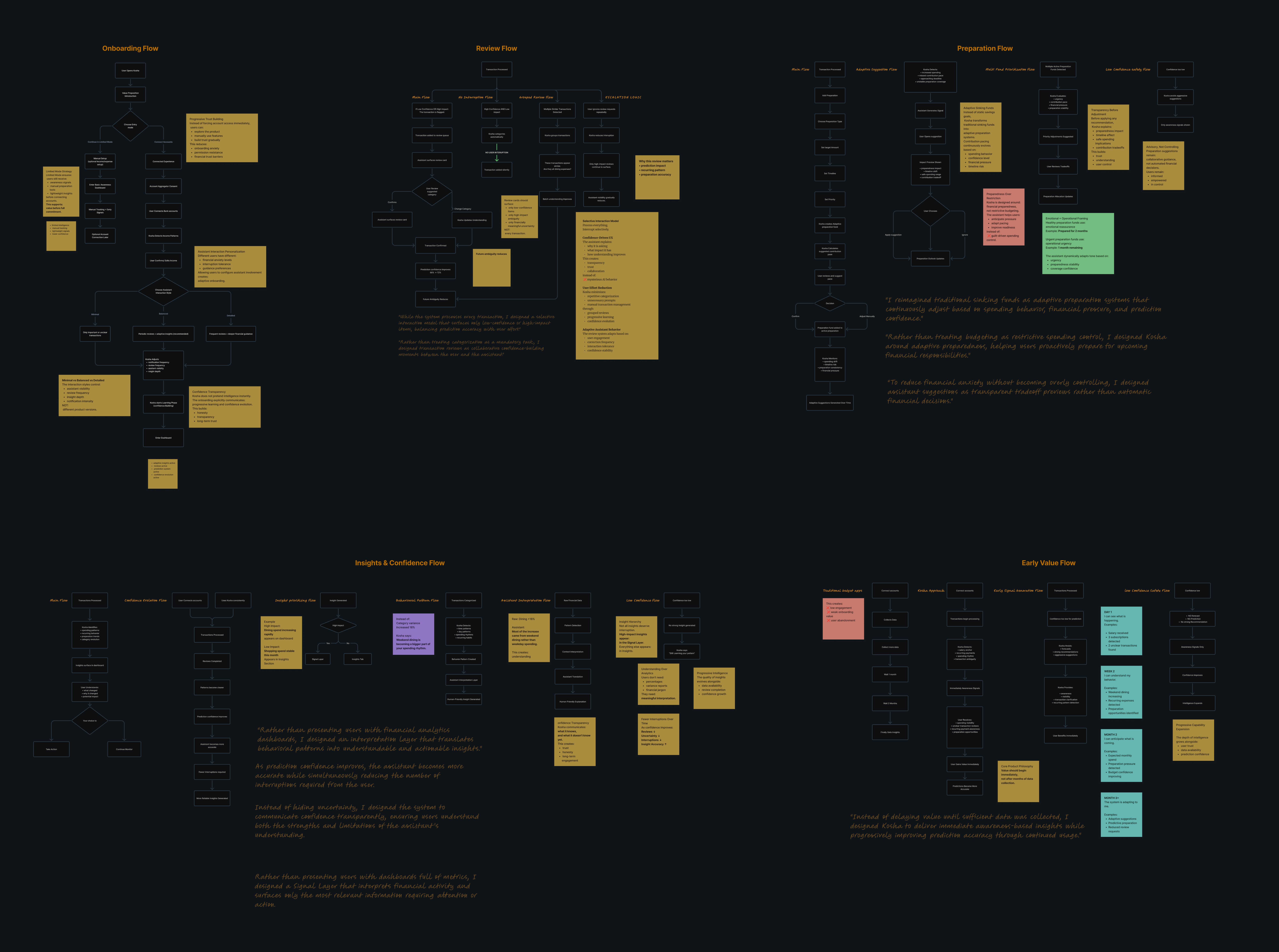
User Flows — Home, Review, Plan, Insights
↗ expand
Low Fidelity Wireframes

Structure before style.

Lo-fi wireframes covering the complete set of flows — focused on layout logic and interaction hierarchy before any visual decisions.
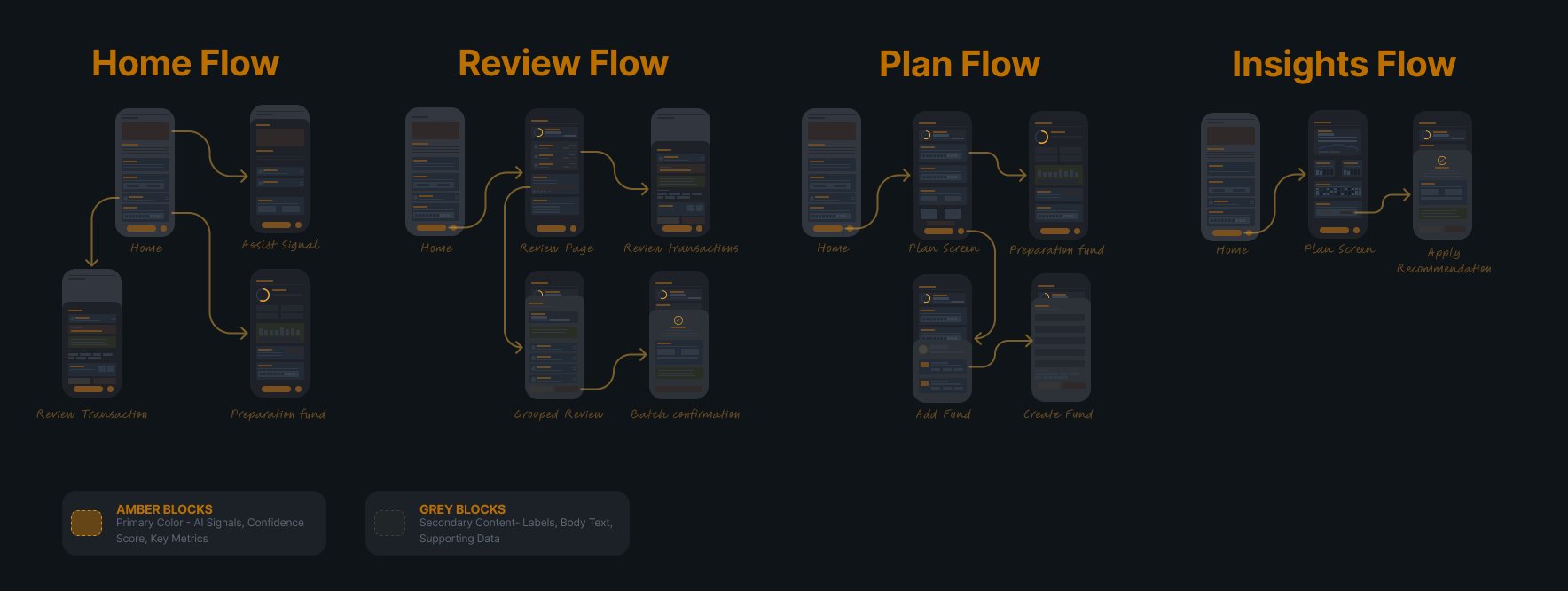
Low Fidelity Wireframes — All Flows
↗ expand
Product Flows
Product Showcase

Intelligence, expressed
with restraint.

Eight flows. Every key interaction in KOSHA — from first open to weekly review — shown as it actually works.

Flow 01 · Onboarding

Early Value Strategy

Instead of waiting for weeks of data, KOSHA delivers immediate awareness from day one. Salary detection, recurring payment discovery, and a starting confidence score — all before the first review.
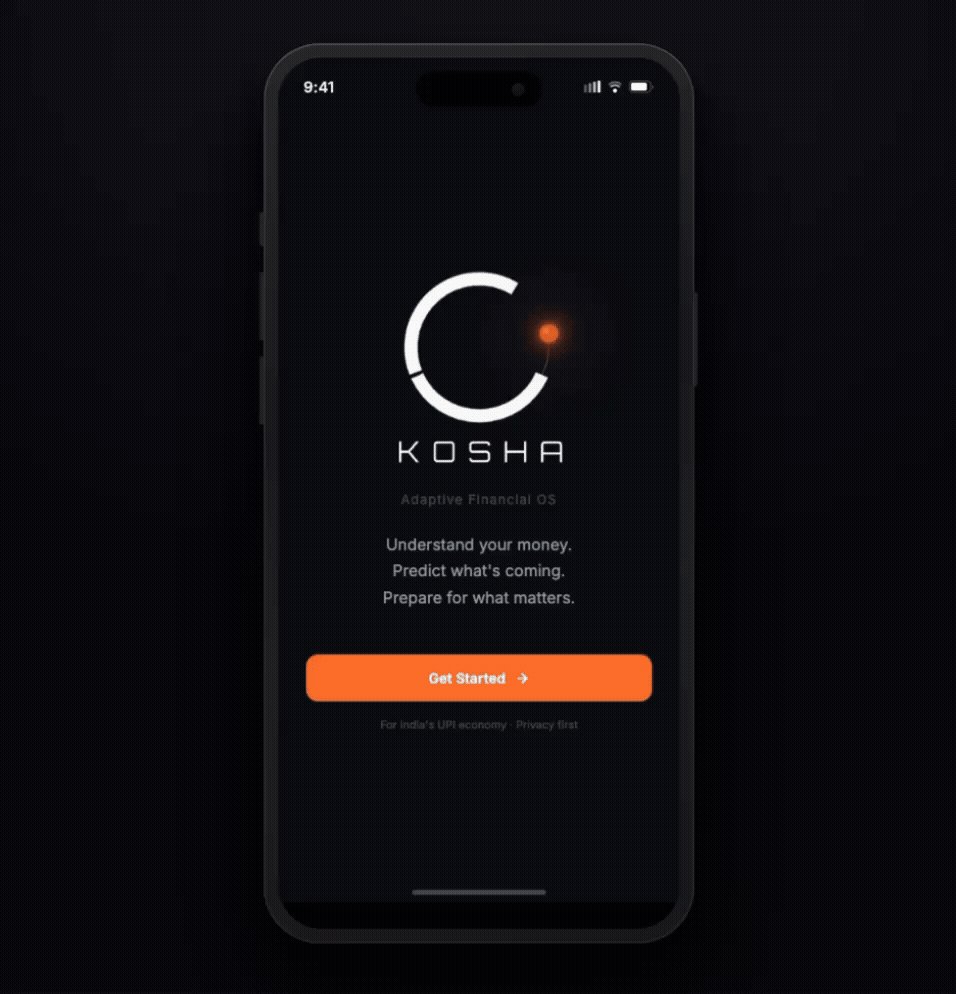
Welcome → Value Prop → Mode Select → AA Consent → Bank Link → Income Confirm
Starting confidence score shown at 29% — honest, not alarming
Users see their first "early value" home state immediately after setup
Design Decision
"Instead of delaying value until sufficient data is collected, I designed the assistant to provide immediate awareness-based insights, while progressively improving prediction accuracy through continued usage."
Onboarding Flow
↗ expand
Flow 02 · Home Screen

Review Now — From Signal to Action

The home screen's Review Needed card surfaces at the right moment — when 3 transactions need attention. One tap takes users directly into the review queue, improving confidence from 72% to 76%.
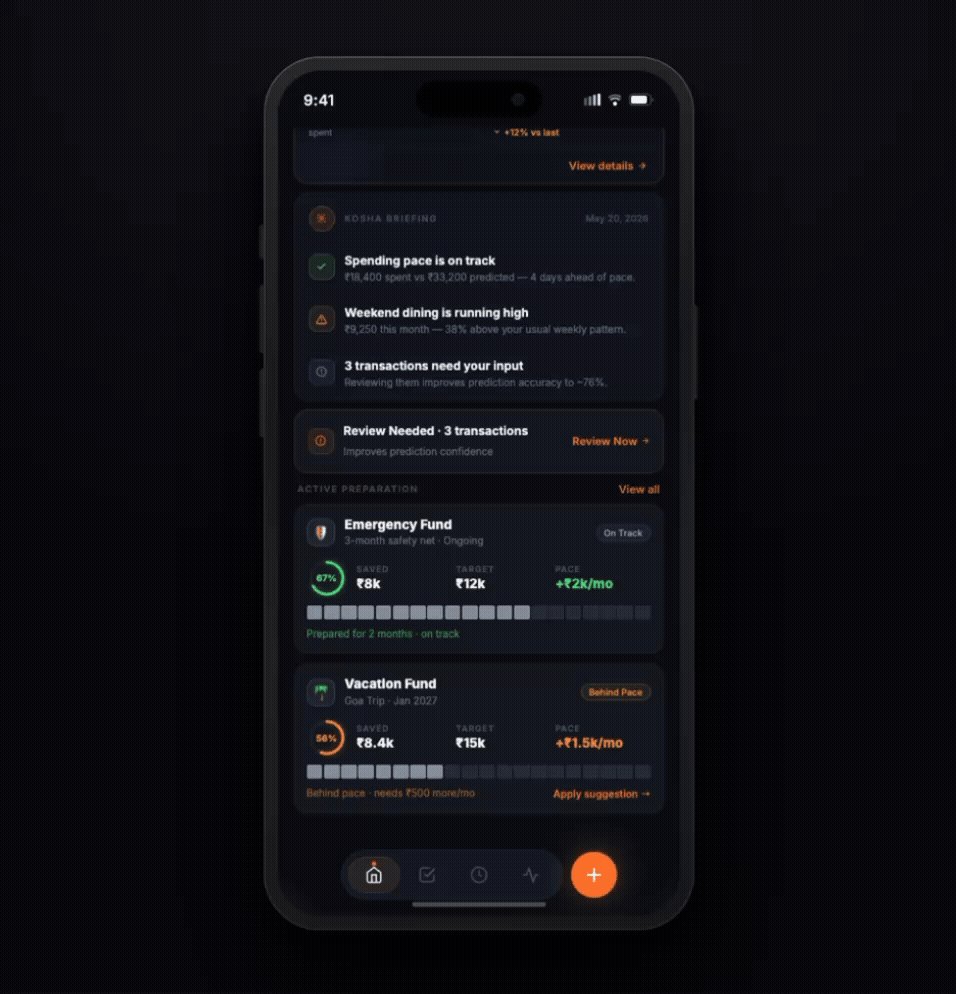
Compact review card on home — not a notification, a contextual prompt
Impact stated upfront: "Reviewing improves predictions to ~76%"
Review queue opens as a bottom sheet — minimal context switch
Home · Review Now
↗ expand
Flow 03 · Home Screen

Preparation Impact — Spending Meets Planning

When weekend dining increases, KOSHA surfaces the downstream impact — your Emergency Fund may be delayed by one month. The system connects daily behavior to future readiness in real time.
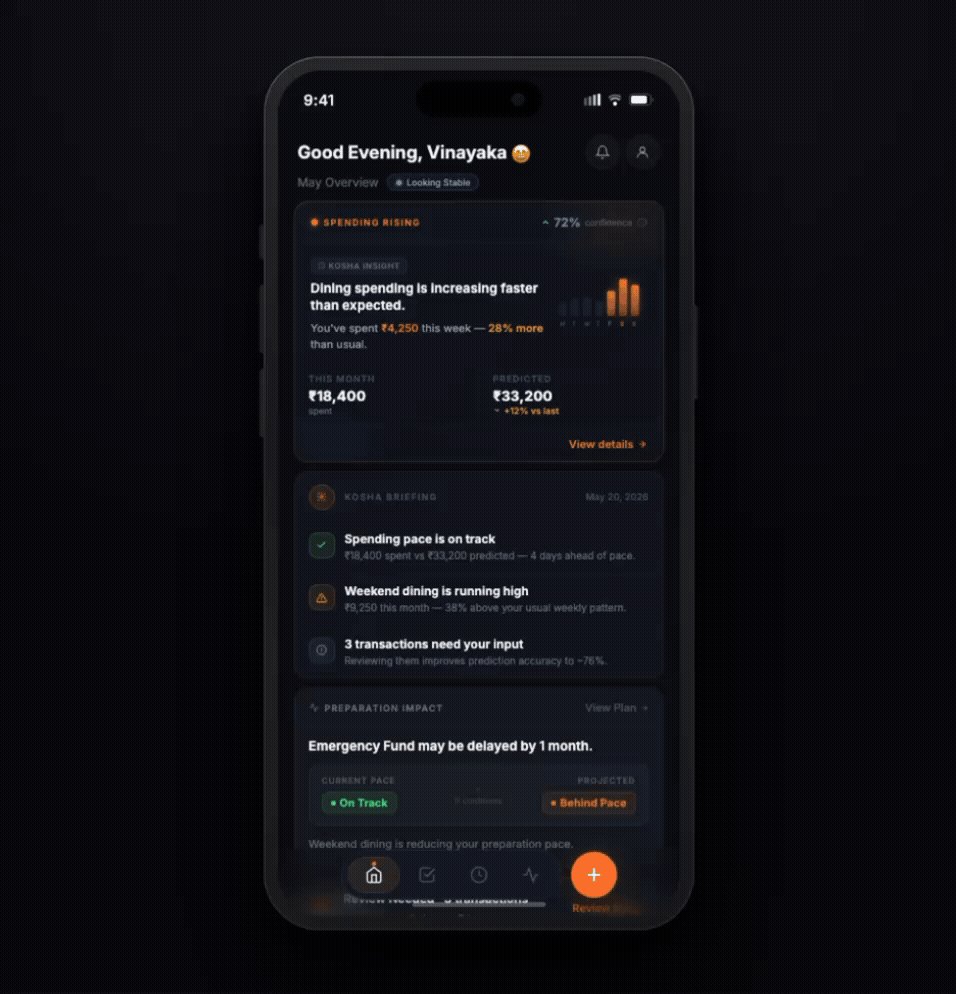
Status transition: On Track → Behind Pace shown visually
Reason explained in plain language — no jargon
Tap through to view the affected preparation fund
Key Innovation
Connecting today's spending to tomorrow's preparedness — in a single card — is the core value of KOSHA's signal layer.
Home · Preparation Impact
↗ expand
Flow 04 · Review

Single Transaction Review

Each low-confidence transaction surfaces with KOSHA's best guess, the confidence level, and simple Confirm / Change options. Every confirmation makes future reviews less necessary.
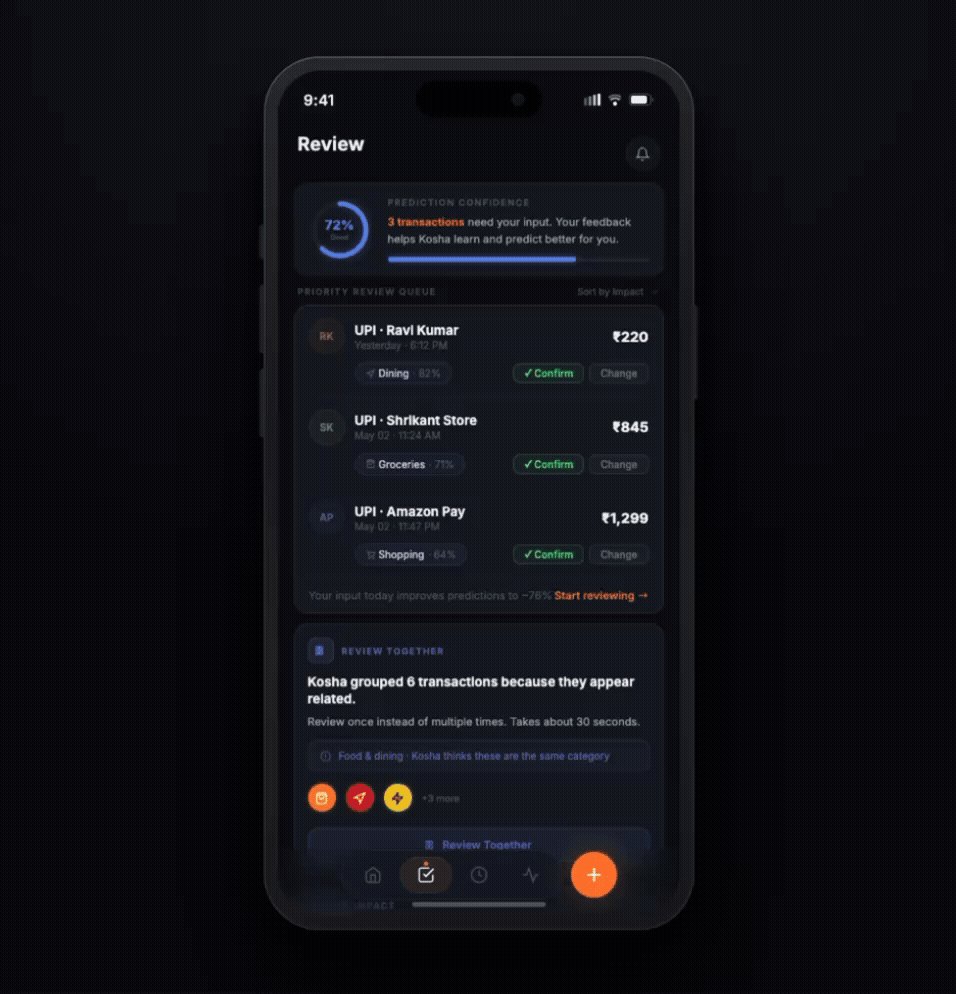
UPI · Ravi Kumar · ₹220 — Dining 82% · Confirm or Change
UPI · Shrikant Store · ₹845 — Groceries 71%
UPI · Amazon Pay · ₹1,299 — Shopping 64%
Design Decision
"While the system processes every transaction, I designed a selective interaction model that surfaces only low-confidence or high-value transactions, balancing accuracy with user effort."
Review · Single Transaction
↗ expand
Flow 05 · Review

Batch Review — Grouped Transactions

KOSHA groups 6 similar transactions — Food & Dining, same pattern — and presents them as a single review. One decision instead of six. Takes about 30 seconds.
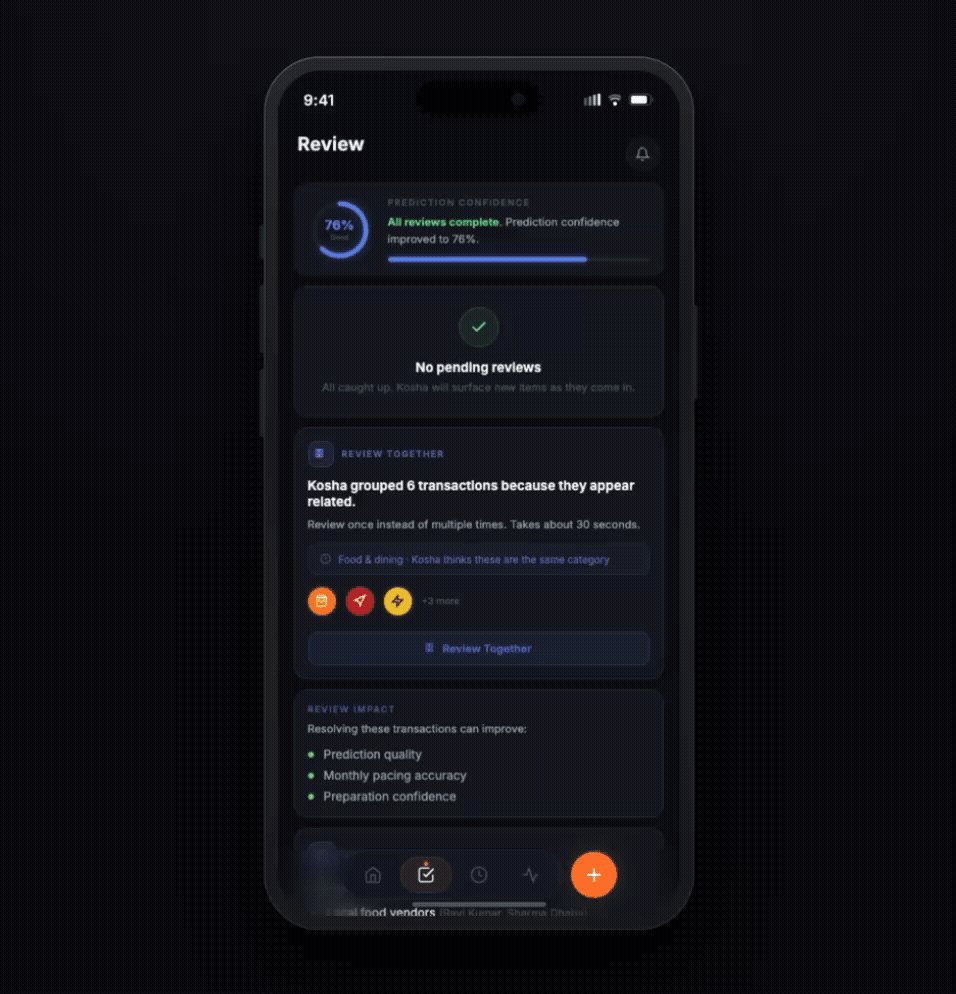
Grouped because they appear related — KOSHA explains why
Review Together button handles all in one confirmation
Review Impact: improves prediction quality, pacing accuracy, preparation confidence
Review · Batch
↗ expand
Flow 06 · Plan

Create Preparation Fund

Adding a new preparation fund is intentionally simple. Users define what they are preparing for, the target amount, timeline, monthly contribution, and category. KOSHA then tracks progress and later identifies when the fund is on track, behind pace, or needs adjustment.
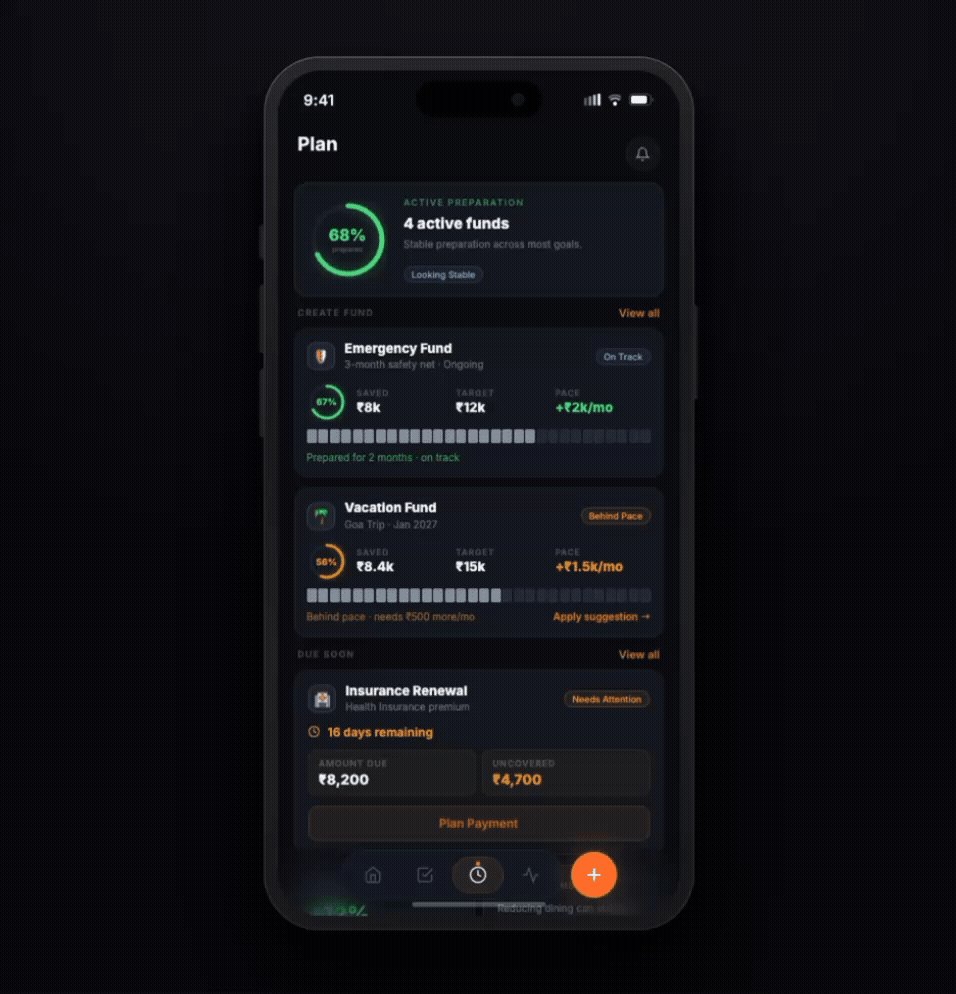
Category selection → Amount → Date → Monthly contribution
User controls the contribution amount
KOSHA tracks progress and surfaces suggestions later when the fund falls behind pace
Plan · Create Fund
↗ expand
Flow 07 · Plan

Apply Adjustment Suggestion

When a fund falls behind pace, KOSHA calculates the exact increase needed and presents it as an actionable suggestion. Current: ₹1,500/mo. Recommended: ₹2,000/mo. Impact: Behind Pace → On Track.
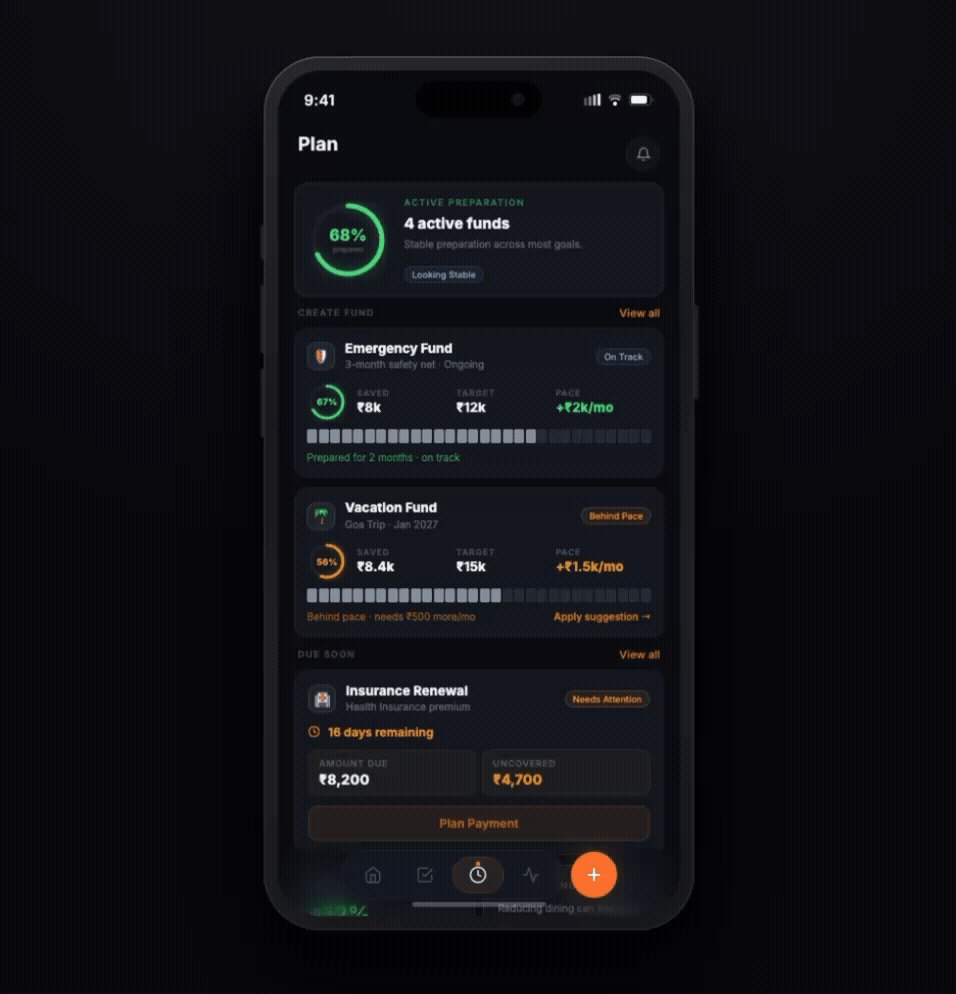
Recommendation framed as improvement trajectory, not failure
User sees exactly what changes and why — full transparency
One tap to apply — or modify before accepting
Design Principle
Recommendations feel supportive rather than controlling. The assistant suggests adjustments. The user remains in control.
Plan · Apply Adjustment
↗ expand
Flow 08 · Insights

Smart Recommendations & Behavioral Patterns

The Insights screen surfaces behavioral patterns that influence future preparedness. Not raw data — interpreted signals. Weekend Drift. Late Night Impulse. Stable Essentials. Safe Spending Range.
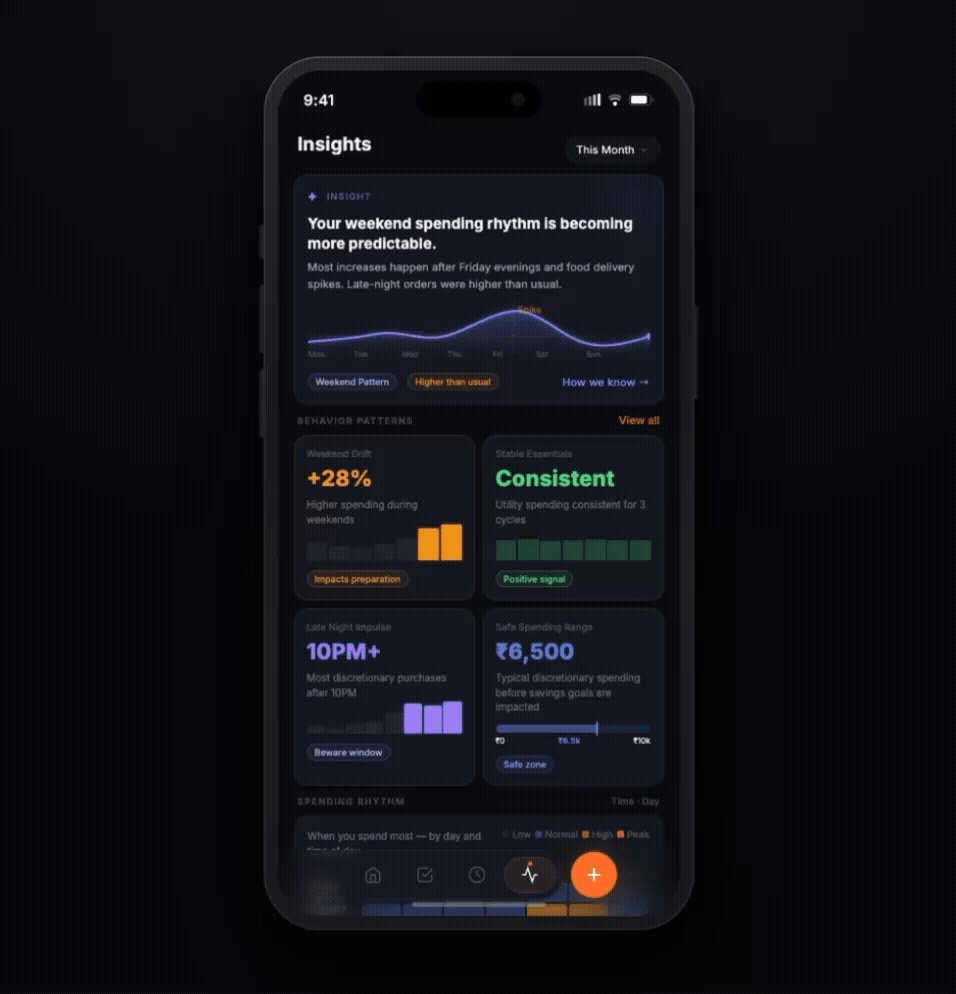
Featured insight: weekend spending rhythm becoming more predictable
Weekend Drift +28% · Stable Essentials: Consistent · Late Night Impulse: 10PM+
Safe Spending Range: ₹6,500 — typical discretionary before goals are impacted
Insights · Smart Recommendations
↗ expand
Live Prototype

Explore KOSHA, interactively.

A fully clickable end-to-end prototype covering onboarding, review, planning, and insights — built to feel like the real product.

Open Full Prototype ↗
Reflection
"Financial confidence is not built through more tracking. It is built through better understanding, proactive preparation, and transparent guidance."
I
The biggest product shift happened when I stopped thinking about budgeting and started thinking about confidence. Users do not wake up wanting better categorization. They want confidence that they are financially prepared.
II
UPI's frictionlessness created a new category of financial problem that Western fintech models do not address. KOSHA had to be designed entirely for this context — not adapted from existing patterns.
III
The selective review model — processing everything, surfacing only what requires human judgment — proved to be the core interaction principle that differentiated KOSHA from the products included in my review.
IV
Trust is not built by being right once. It is built by being transparently reasoned every time. Users don't just want the answer — they want to understand why the answer is right.
IV·b
A decision that changed direction: My first design asked users to categorise every transaction manually — a complete review flow. In early feedback conversations, people described it as "too much work" and "feels like bookkeeping." That response killed the idea. It led directly to the selective review model: Kosha processes everything automatically and only surfaces transactions where user input genuinely improves predictions. Research removed a feature, not just refined one.
V
Users rarely want more financial data. They want more certainty. The most valuable design opportunities were not found in dashboards or charts — they were found in reducing uncertainty, increasing confidence, and helping users prepare for what comes next.
→
What is not yet validated: The prototype has not been tested with target users in a structured usability study. The next step is task-based usability testing focused on three areas: comprehension of the selective review flow, understanding of the confidence score, and completion of the preparation fund setup. Current design decisions are informed by exploratory research and design reasoning — not measured outcomes. That gap is the honest state of this work.
End of Case Study

Most finance apps help users
track money.
KOSHA helps users understand,
prepare, and build confidence.

An Adaptive Financial Operating System for India's UPI economy — designed to close the gap between financial data and financial clarity.

Designer
Vinayaka Kamana
Research
8 Weeks · India
Domain
Fintech · AI · UPI
Status
Concept · Prototype